Math conventions
Mathematical typesetting adheres to some details that unfortunately seem to be not so well known.
1. Variables and variable functions: slanted
Wrong:

\begin{align}
  \mathrm{f(x) = a x + b}\\
\end{align}
Right:

\begin{align}
  f(x) = a x + b
\end{align}
Note that LaTeX does that right by default.
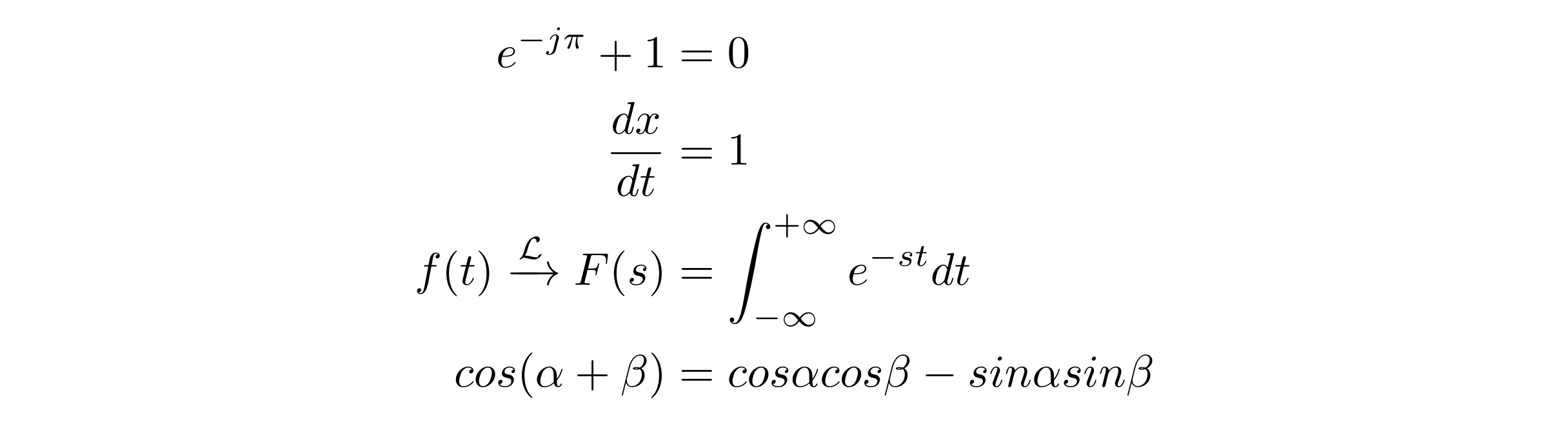
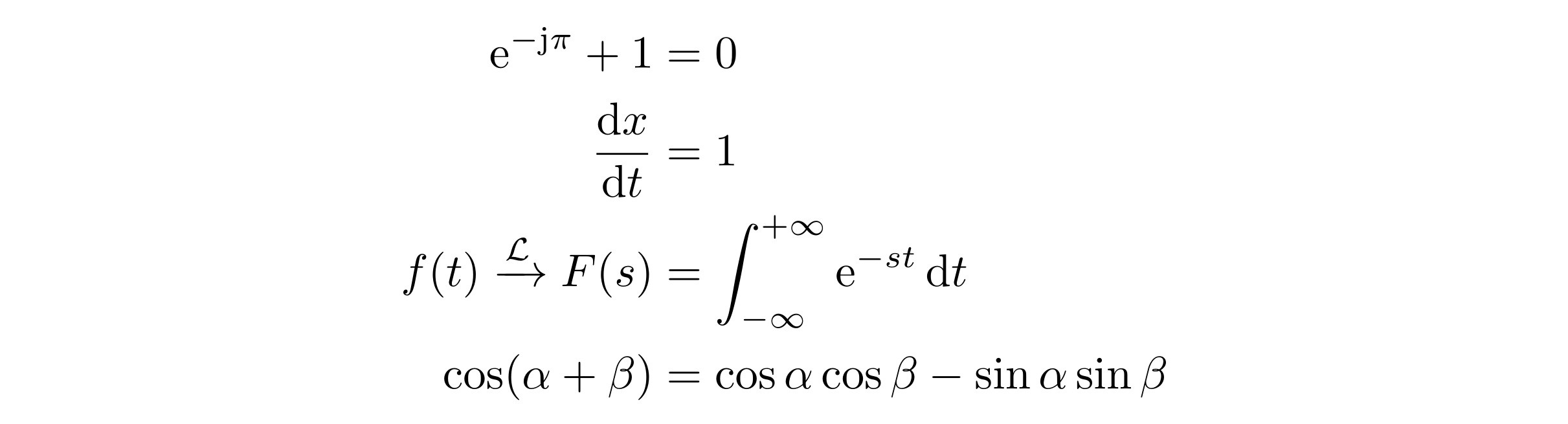
2. Constants, dedicated functions and operator symbols: upright
Wrong:
\begin{align}
  e^{-j\pi}+1 &= 0\\
  \frac{dx}{dt} &= 1\\
  f(t) \xrightarrow{\mathcal{L}} F(s) &= \int_{-\infty}^{+\infty} e^{-st} dt\\
  cos(\alpha+\beta) &= cos\alpha cos\beta - sin\alpha sin\beta
\end{align}
Right:
\begin{align}
  \mathrm{e}^{-\mathrm{j}\pi}+1 &= 0\\
  \frac{\mathrm{d}x}{\mathrm{d}t} &= 1\\
  f(t) \xrightarrow{\mathcal{L}} F(s) &= \int_{-\infty}^{+\infty} \mathrm{e}^{-st}\,\mathrm{d}t\\
  \cos(\alpha+\beta) &= \cos\alpha \cos\beta - \sin\alpha \sin\beta
\end{align}
Note that LaTeX does not do that right by default. Personally, I use the following shorthand macros:
\newcommand\eu{\mathrm{e}}
\newcommand\ju{\mathrm{j}}
I advize you to use the physics package to typeset the roman d for integrals and derivatives. It also provides nice features for nabla-related calculus.